Felixnews.com – A new era of space exploration has officially begun. On April 1, 2026, NASA successfully launched the Artemis II mission from Launch Complex 39B at the Kennedy Space Center in Florida. This mission marks the first time humans have traveled to lunar orbit in more than 50 years since the end of the Apollo program.
Based on official NASA data, here are some interesting facts and key highlights from this first crewed mission in the Artemis program:
Returning to Deep Space After Half a Century
NASA Artemis II mission will take humans more than 380,000 kilometers from Earth. The last time such a distance was traveled was by the Apollo 8 crew in 1968. The Orion capsule, named Integrity, will carry the crew farther from Earth than any human mission in history, venturing into deep space—a realm previously explored only by unmanned spacecraft.
A New Generation of the “Earthrise” Phenomenon
One of the most anticipated moments is the crew’s opportunity to witness the “Earthrise” phenomenon once again. This is the sight of Earth rising above the lunar horizon. This iconic image was first captured during the Apollo era and succeeded in shaking the world’s consciousness regarding just how beautiful and fragile our planet is. Now, with modern camera technology, the world will see “Earthrise” in unprecedented quality.
The Legendary Artemis II Crew
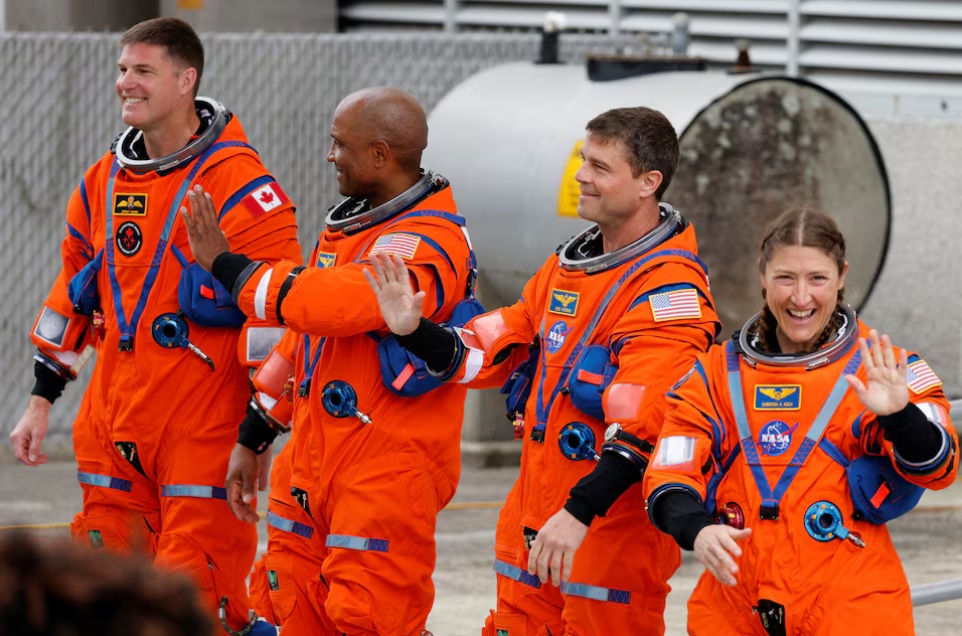
Inside the Orion capsule, four astronauts are currently on their way to the record-breaking distance ever traveled by humans from Earth:
- Reid Wiseman (Commander)
- Victor Glover (Pilot)
- Christina Koch (Mission Specialist)
- Jeremy Hansen (Mission Specialist – CSA)
Foundations for Mars
It’s important to understand that the Artemis program isn’t just about returning to the Moon. This mission serves as a testing laboratory for long-term life support technologies and systems. The data collected during this 10-day journey will lay a crucial foundation for NASA’s next major ambition: sending humans to Mars in the coming decade.
Most Powerful Rocket Power
This successful launch was propelled by the Space Launch System (SLS) rocket, which generated an incredible 8.8 million pounds of thrust at liftoff. This is 15% more than the Saturn V rocket used during the Apollo era, making it the most powerful rocket ever to successfully launch humans into orbit.
Manual Maneuvering Test
Unlike automated missions, on Artemis II, astronauts will demonstrate close-in operations. They will attempt to manually control the Orion capsule to approach the separated rocket section. This test is crucial to ensure humans retain full control if automated systems experience problems in space.
The Artemis II mission demonstrates that the sky’s the limit, not the end, but the beginning of a new chapter of exploration. With a diverse crew and cutting-edge technology, this journey to lunar orbit conveys the message that Earth is ready to venture further into the solar system.